Quick answer: for a small manufacturer (10–100 employees), off-the-shelf ERP realistically costs $15K–$60K in year one (licenses, implementation partner, customization) and fits if your processes are standard. A custom ERP costs $40K–$150K to build but wins when your production flow is genuinely unusual, licensing scales painfully with seats, or the off-the-shelf system would force workarounds on the factory floor. I built and maintained one for a manufacturer from May 2025 until its handover in September 2026; this is the math I use with clients.
What "Off-the-Shelf" Really Costs a Small Manufacturer
- Licenses: $50–$200 per user per month for the mainstream SME suites (Odoo, NetSuite, Business Central, Katana). 20 users ≈ $12K–$48K/year, forever.
- Implementation: the quiet budget-killer — partners typically charge 1–2× the first-year license cost to configure, migrate and train.
- Customization ceiling: the moment you need a workflow the vendor didn't anticipate (multi-stage quality control tied to shipping pallets, say), you're paying partner day-rates or changing how your factory works to fit the software.
What a Custom Build Involved: SPSTARPLAST
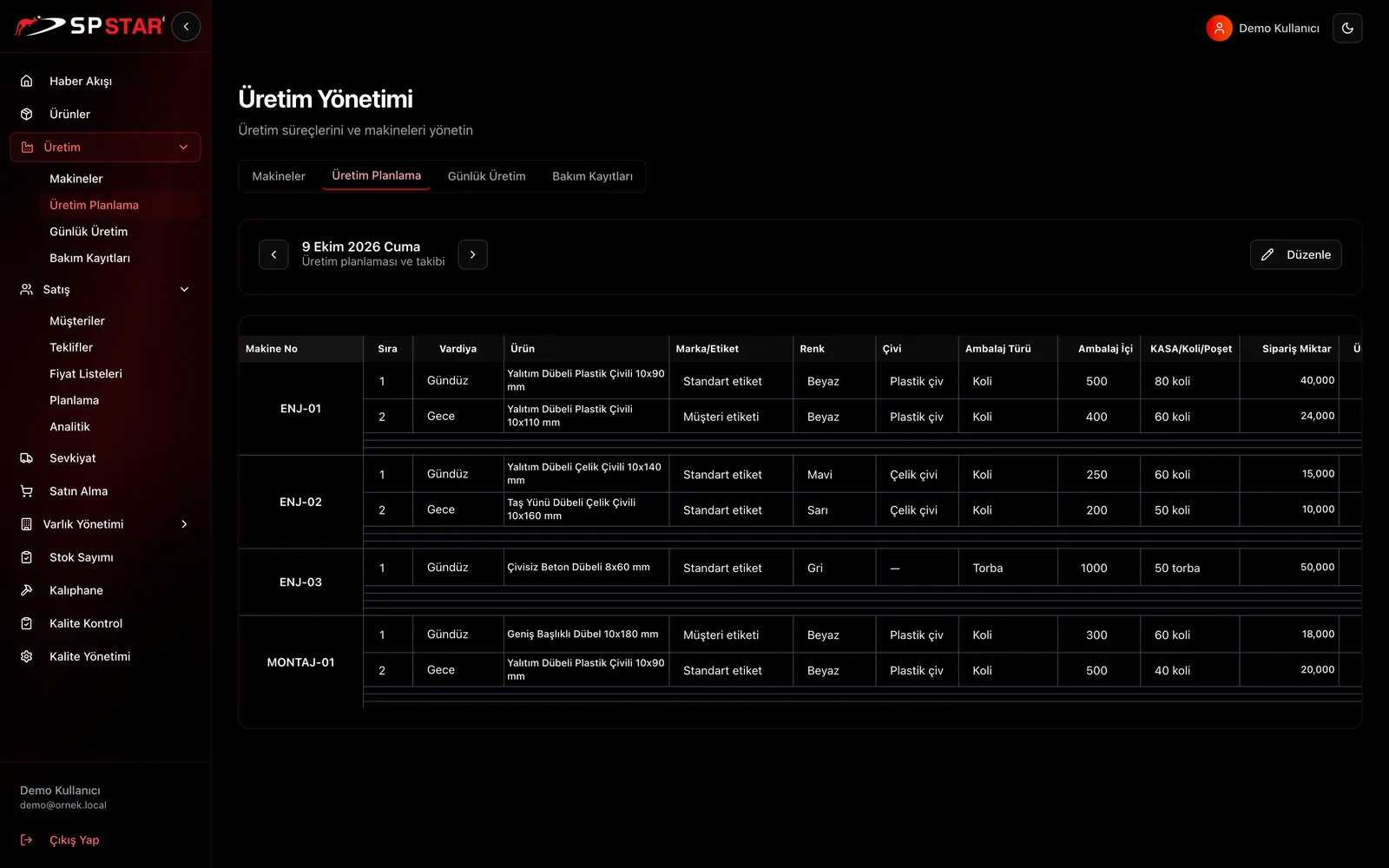
I was the sole developer of the SPSTARPLAST ERP for an insulation-anchor manufacturer: 16 modules and 50+ screens covering sales, production, inventory, quality, shipping and purchasing, with a Turkish interface, per-user access control and 17+ active users. The parts that matter for a build-vs-buy decision:
- 90+ database tables, 50K+ lines of code: a real system, not a spreadsheet replacement.
- Stack: Next.js 15 and Supabase PostgreSQL, with business rules such as document numbering and order totals in database functions and triggers. There is no per-seat licensing, so adding a user adds no license fee.
- LOGO ERP integration: customer, supplier and stock cards sync in from LOGO, and accepted quotes go back to LOGO as sales orders, so accounting stayed in the system the company already used.
- Full audit trail of who changed what and when.
- Handover: in September 2026 the code, database and hosting moved to the client's own GitHub, Supabase and Vercel accounts, with documentation and a written technical-debt report.
Build vs Buy: the Decision Table
| Signal | Buy off-the-shelf | Build custom |
|---|---|---|
| Your processes | Standard make-to-stock, common workflows | Unusual flows the vendor demo can't show |
| Team size | Under ~10 ERP users | 15+ users where per-seat fees compound |
| 5-year cost | $60K–$250K+ (licenses + partner work) | $40K–$150K build + modest maintenance |
| Time to live | 3–6 months | 4–9 months |
| Change requests | Partner day-rates, vendor roadmap | Your developer, your priority list |
| Risk profile | Vendor lock-in, price increases | You own it — and must maintain it |
The Hybrid Most People Miss
Accounting almost never needs to be custom: keep QuickBooks or your local equivalent and integrate, as SPSTARPLAST did with LOGO. The custom value is in the 20% of workflows unique to your factory: production scheduling against real machine capacity, quality gates, shipping consolidation. Build that; buy the commodity.
Running a small factory and weighing an ERP? Book 30 minutes with me and bring the spreadsheets you run on today. I'll tell you which modules are worth building and which you should simply buy.
Frequently Asked Questions
How much does a custom ERP cost for a small manufacturer?
Expect $40K–$150K depending on module count and integrations, with no per-seat licensing afterwards.
How long does a custom ERP take?
4–9 months to production for an SME scope, shipped module by module: sales and inventory first, then production, quality and shipping.
Is Odoo cheaper than building custom?
For standard processes, usually yes in year one, but the 5-year totals converge once you add partner customization and growing seat counts. Model both over 5 years, not 1.
Related: build vs buy vs hybrid for software generally · the SPSTARPLAST case study · ERP development service · manufacturing software development.